
A size 12 in 1958 is roughly a size 4 today. Sizing was never a measurement.
The United States wrote a national sizing standard, watched nobody follow it, and withdrew it. What replaced it is why the same number fits differently in every shop.
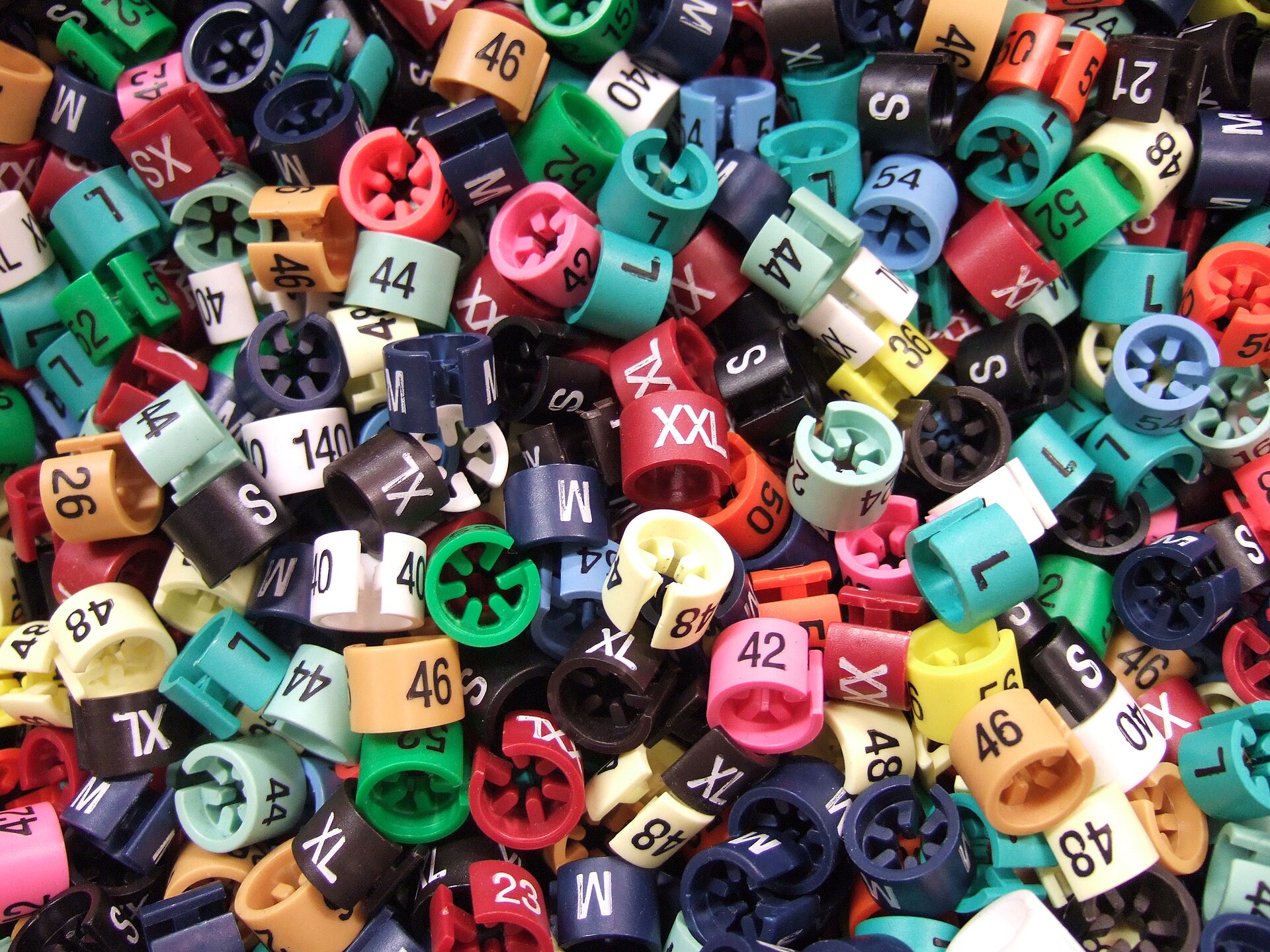
In 1958 the United States National Bureau of Standards published Commercial Standard CS 215-58, a table of body measurements for women’s clothing sizes. It was built on a 1939–40 anthropometric survey of roughly fifteen thousand women — the first serious attempt anywhere to measure a population for the purpose of dressing it — and it proposed a system of even-numbered sizes from 8 to 38, with letters for tall, regular and short. Under CS 215-58 a misses’ size 12 had a 34-inch bust. It was, for a moment, a genuine standard: a number on a label that meant a set of inches anywhere in the country.
It was also voluntary, and manufacturers ignored it almost immediately. By the 1970s compliance was so thin that the standard was an embarrassment, and in 1983 it was withdrawn. ASTM, the private standards body, published its own tables in 1994 as D5585, drawing on the same 1939 survey together with military anthropometric data, and has revised them since. Under ASTM D5585-11 the same misses’ size 12 measures roughly 39 inches at the bust. Five inches migrated into the same number in fifty years, and — this is the part that matters — ASTM’s tables are voluntary too. No brand is obliged to follow them, and most do not.
This is what “vanity sizing” means when it is said precisely. Not merely that brands flatter — though the migration of a 1958 size 8 body into today’s size 0 or 2 is flattery on an industrial scale — but that a size is a label a brand chooses, anchored to nothing outside the brand. Two shops on the same street can put the same body into a 10 and a 14 and both be correct, because there is no longer anything to be correct against. A size is a name for a range, and each brand names its own ranges.
The consequence is quietly enormous. Returns in online apparel run far above other categories, and fit is the reason most often given. Every returned parcel is a garment shipped twice, handled, inspected, often marked down and sometimes destroyed. A meaningful share of the industry’s waste is not overproduction in the sense the sustainability reports mean. It is the right garment in the wrong size in the right box, sent back because the number on the label was a guess about a body it had never met.
The drift was not accidental, and it is worth being clear about why it happened. Once the standard was voluntary, a brand that cut its size 12 a little larger than the table let a slightly larger customer buy a 12 instead of a 14, and she came back. The next brand had to follow or lose her. Fifty years of that, one inch at a time, is how five inches migrated into a number; nobody decided it, and nobody can reverse it alone, because the first brand to re-anchor its sizes would be telling its customers they had gone up two sizes overnight. It is a textbook coordination failure, and the label is where the failure is printed.
The same drift is why sizes cannot be converted between countries by any table that stays true for long. A UK 12, a US 8 and an EU 40 were once the same body and are now three brands’ guesses about three markets. The conversion charts on retail sites are not wrong so much as expired, and the returns figures are the receipt.
Ease is the term that closes the gap between a body measurement and a garment measurement, and it is why a chart of body sizes was never going to be enough on its own. A fitted shirt might be cut with five centimetres of ease at the chest over the body it is meant for; an oversized one with twenty-five. Both fit, in the sense their designers intended, and both would be rejected by a naive comparison of garment to body. A fit engine has to know the intended ease of the style as well as the numbers of the piece, and it learns that from the pattern, the product category and, over time, from which garments a wearer keeps and which she returns. The label knows none of this. The centimetres, with a little context, know all of it.
Measurements do not have this problem, which is why tailors have never had it. A garment has a bust, a waist, a hip, a length, a sleeve — in centimetres — and a body has the same. ISO 8559 exists to standardise how those body dimensions are defined and taken, so that a waist measured in Doha means the same as one measured in Milan. Compare the two sets of numbers, with an allowance for the ease the garment was cut with, and fit stops being a guess about a label and becomes an arithmetic question with an answer.
That is the model ZIMRICS is built on, and it is why the app asks for the things it asks for. A garment’s record carries its measurements, not just its size; the size on the label is stored as what it is — a brand’s name for a range, useful for finding the right rail and useless for anything else. A profile can carry height, weight and, if the wearer chooses, the body dimensions that decide fit. The comparison is done in centimetres. When the app says something will fit, it is saying that two numbers are close, not that a label matched a label.
Measuring garments is the tedious half of this, and it is the half the computer-vision work I have done is aimed at. A flat photograph of a garment against a known reference yields its key dimensions to within a centimetre or two — enough to rank fit, and far better than any label. Measuring bodies from photographs is harder and more sensitive, in both senses, which is why it is optional, done on the device where possible, and never required to use the rest of the app. But the direction is clear: the tape measure is being replaced by the camera, and the label is being replaced by nothing, because it never measured anything.
Until labels are anchored again — and there is no sign anywhere in the industry that they will be — the advice is unglamorous. Know four of your own measurements. Buy from brands and garments that publish theirs. Ignore the number in the seam entirely when comparing two shops. And when someone tells you they are a size 12, ask them: in what year?
Sources
- Vintage Unscripted — Decoding vintage women’s clothing sizing (CS 215-58, its withdrawal, ASTM D5585)
- Comparison of women’s sizes from SizeUSA and ASTM D5585-11 sizing standard (ResearchGate)
- Tailor Size Guide — Vanity sizing explained: why a size 8 isn’t always a size 8
- The Curvy Fashionista — 12 facts about the history of women’s clothing sizes