
The capsule wardrobe is not a fashion idea. It is a decision budget.
Susie Faux named it, Donna Karan sold it, and a jam stall in California explained why it works.
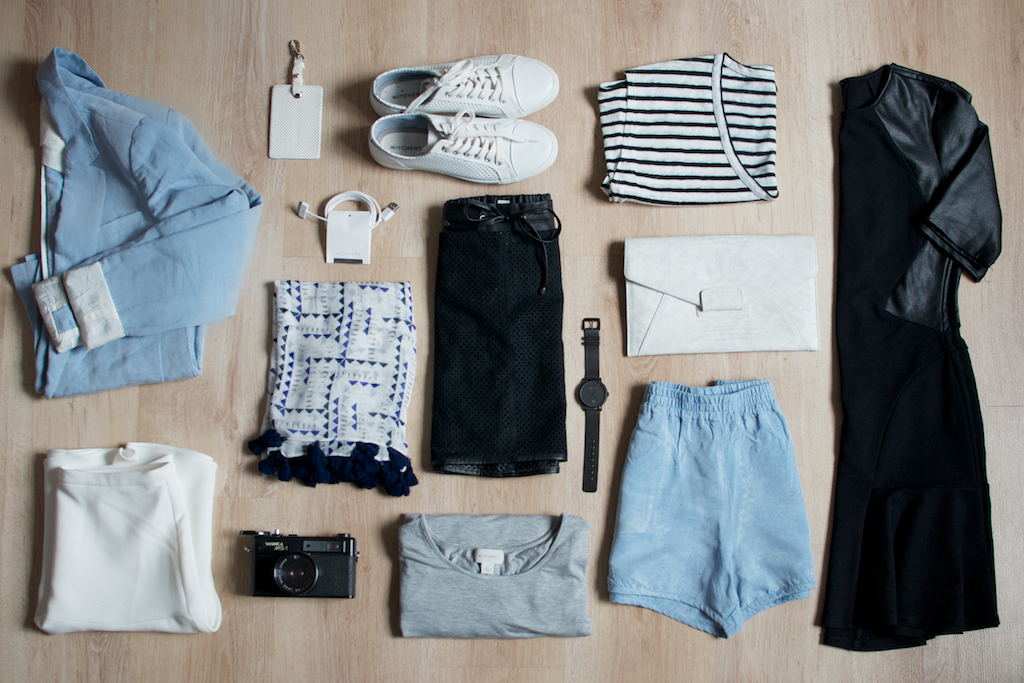
The phrase belongs to Susie Faux, who ran a London boutique called Wardrobe in the 1970s and used “capsule wardrobe” for a small set of pieces that do not date — the skirt, the trousers, the coat — to which seasonal things are added on top. Donna Karan made the idea famous in 1985 with Seven Easy Pieces: a bodysuit, a skirt, a tailored jacket, a dress, something in leather, a white shirt and a cashmere sweater, each cut to combine with the others so that a working woman could travel with one bag and dress for a week. Forty years of lifestyle content has treated the capsule as an aesthetic, a kind of beige minimalism with rules about how many hangers you are allowed. It is far more useful read as what it actually is: a piece of behavioural economics that happens to be about clothes.
The economics were demonstrated at a jam counter. In 2000 Sheena Iyengar and Mark Lepper set up a tasting stall in an upmarket California grocery and alternated between offering six flavours of jam and twenty-four. The larger display drew more people to stop — sixty percent of passers-by against forty — and converted three percent of them into buyers. The smaller display drew fewer browsers and converted thirty percent. The result became the founding study of what is now called choice overload, and it has been argued over ever since; later meta-analyses find the effect is real but conditional, strongest when options are hard to compare and the chooser has no clear preference. That caveat is not a weakness for our purposes. It is a precise description of a wardrobe: forty tops that are all slightly different is the twenty-four-jam table, presented every morning to someone who has not yet had coffee.
Barack Obama put the same idea in one sentence to Michael Lewis in Vanity Fair in 2012: “You’ll see I wear only grey or blue suits. I’m trying to pare down decisions. I don’t want to make decisions about what I’m eating or wearing, because I have too many other decisions to make.” He cited research suggesting that the act of making decisions degrades the ability to make further ones. The strong version of that claim — a depletable reservoir of willpower — has had a rough decade in replication. The modest version needs no reservoir at all: a decision you do not have to make in the morning is attention you keep for the day, and attention is the thing most of us are actually short of.
So the capsule is a budget, and the interesting question is how to spend it. This is where the popular version goes wrong, because it treats the number of pieces as the goal — thirty-three, or thirty-seven, or whatever this season’s challenge prescribes. Counting hangers optimises the wrong thing. What you want is the number of good outfits per decision, and that is a property of the set, not of any garment in it. A capsule of twelve pieces that all combine produces more real choices than a wardrobe of eighty that mostly do not, and it does so with a fraction of the morning’s effort. Faux understood this; her original definition was about pieces that go with each other, not about how few there were.
The number that actually describes a capsule is not its size but its outfit count, and the arithmetic of that is worth a moment. Five tops and four bottoms that all combine give twenty outfits; add three layers that go with everything and it is sixty; add two pairs of shoes and it is a hundred and twenty. Twelve pieces, a hundred and twenty ways to dress, and the count only holds if the combinability is real — if one top clashes with two of the bottoms, the number falls by a fifth. This is why the discipline of the capsule is about the joins, not the pieces: every purchase is judged by how many outfits it adds, and a piece that goes with nothing adds one.
Combinability is a computable property, which is the part fashion writing tends to miss. Given the garments you own — their colours as measured values, their occasions, their warmth, what has been worn recently — an outfit for a given day is a constrained search, not a mood. The constraints are the forecast, the calendar, the walking in the day and the desire not to repeat Tuesday. The search space is every combination of what you have. A human does this badly under time pressure, which is why the jam table wins. Software does it in milliseconds and, done properly, shows its reasoning.
That is the job ZIMRICS’s Stylist was built for. Today’s Pick composes an outfit in steps — the dress, then the footwear, then the pieces that suit the room — and each step says why. The morning decision becomes a yes, or a reshuffle of one step, rather than a blank stare at a rail. In capsule terms, the software keeps the promise of fewer decisions without asking you to own less than you want to. You can have the eighty pieces. You just do not have to search them yourself.
There is a second-order benefit that the capsule literature gets right and rarely explains. A set chosen for combinability is a set with a small palette, a consistent level of formality, and a shared silhouette — which is to say, it looks like it belongs to one person. That coherence is what people mean when they say someone “has style”. It is not a talent. It is what a well-constrained set looks like from the outside, and it can be built deliberately, or computed.
If you want to build one by hand, the rules that survive the research are Faux’s originals plus one. Choose pieces you will still wear in five years. Make sure each goes with most of the others — actually check, on the bed, not in your head. Add seasonal pieces on top rather than swapping the core out. And count outfits, not hangers: the day you can dress for a week from what is on the rail without thinking, the capsule is finished, whatever number that turns out to be.
Sources
- Capsule wardrobe — origins with Susie Faux and Donna Karan’s Seven Easy Pieces (Wikipedia)
- Iyengar & Lepper (2000) — When choice is demotivating: the jam study, explained
- Fast Company — Always wear the same suit: Obama’s productivity secrets (Vanity Fair, 2012)
- Decision fatigue — overview and replication debate (Wikipedia)